
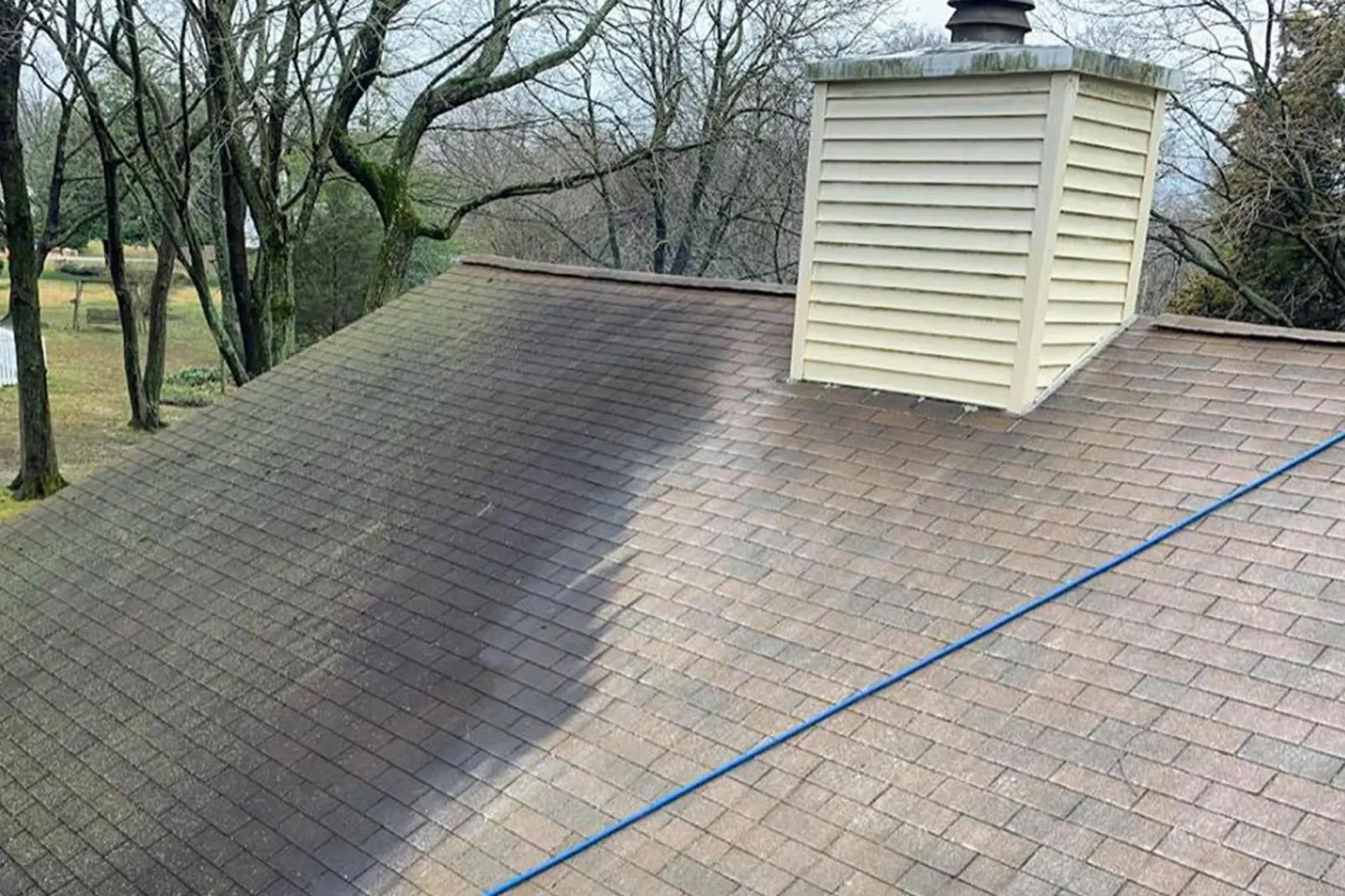
What Are the Black Streaks on Your Roof?
Those black streaks are algae, not dirt. The organism is Gloeocapsa magma, a blue green algae that lives on shingles. Rain will not rinse it away. A brush will not scrub it off either.
The fix is a soft wash. That means low pressure water plus cleaning solutions that kill the growth at the root. Shingle makers point to the same approach. High pressure is the one thing that should never touch a shingle roof.
What Is Gloeocapsa Magma?
Gloeocapsa magma is a cyanobacteria. That is a bacteria that feeds on sunlight the way a plant does. The Asphalt Roofing Manufacturers Association calls it the most prevalent of the algae species behind roof discoloration.
The organism itself is blue green. It reads as black because of the coat it grows for protection. CertainTeed says the streaks look black because of the dark pigmented sheath the algae grows for sun protection.
Spores travel on wind and on animals. One stained roof seeds the roofs around it. That is why a whole street can start streaking within the same few years.
Why Does Algae Grow on Shingles?
Asphalt shingles are made with crushed limestone as a filler. Limestone is calcium carbonate, and that is food for this organism. Your roof is a food source sitting out in the open for decades.
The growth starts high on the slope and works its way down. Rain carries it, so the stain runs in vertical streaks toward the gutter. That downhill pattern is the tell that you are looking at algae.
Check under any metal flashing or vent cap on a streaked roof. There is usually a clean stripe running below it. Rain washes metal ions off that flashing, and the algae cannot hold on in that path.
Why Are Roof Streaks So Common Around San Antonio?
Algae needs moisture and time. San Antonio gets about 32.4 inches of rain across 81 wet days a year, per published long term weather averages. Mornings do most of the work. Average humidity here runs near 83 percent at 6 a.m. before falling to 48 percent by mid afternoon.
Then the heat arrives. The city averages 122 days a year in the 90s. Warm, damp shingles are ideal ground for this growth.
Shade decides which slope goes first. North facing slopes dry slowest, so they streak first. A roof under live oaks holds that damp far longer. Keeping the gutters clear helps, because a clogged gutter holds water at the bottom edge of the roof.
Do Black Streaks Shorten the Life of Your Roof?
The real answer runs against a lot of roof cleaning marketing. ARMA states there is no scientific evidence that algae is damaging to asphalt shingles. What the streaks clearly hurt is how the roof looks.
There is one measurable effect past looks. Dark staining cuts how much sun a light roof reflects. ARMA notes that algae reduces the effectiveness of reflective cool roofs. In a Texas August, that reflectivity is doing real work.
Moss and lichen are a different story. ARMA warns that moss can lift or curl shingle edges, which raises blow off risk in wind. Heavy moss can also push water sideways and reach the roof deck. If the growth on your roof is thick and spongy instead of flat, it needs attention sooner.
Can Roof Cleaning Void Your Shingle Warranty?
A shingle warranty covers defects in the shingle itself. Damage done during cleaning is not a defect, so it sits outside that coverage. Manufacturers also exclude damage from abuse and from poor maintenance.
ARMA is blunt about method. Never use a pressure washer on an asphalt shingle roof. ARMA says it causes granule loss and very likely early failure of the roof system. Brushes and brooms carry the same warning.
Some shingles come with their own algae coverage. GAF warrants StainGuard Plus shingles for 25 years against blue green algae discoloration. CertainTeed covers its algae resistant lines for 10 or 15 years, depending on the product. Those terms sit with the shingle and say nothing about a cleaning done later.
How Do You Remove Black Streaks From a Roof?
ARMA publishes an actual recipe for it. The mix is 50:50 laundry strength liquid chlorine bleach and water. It goes on with a sprayer and sits for 15 to 20 minutes. Then it gets rinsed off with low pressure water. That is soft washing, described by the industry body itself.
Here is how the usual options compare.
| Removal option | What it does to the stain | What manufacturers say |
|---|---|---|
| Professional soft wash | Kills the growth at the root, then a low pressure rinse carries it off | The approach ARMA describes for algae and moss |
| Pressure washing | Blasts the stain and the granules off together | ARMA: never use a pressure washer on an asphalt shingle roof |
| Brush or broom scrubbing | Loosens the granule layer and smears the stain around | ARMA: do not use any type of brush or broom on the roof |
| Store bought cleaner from the ground | Can lighten the lower edge that is within reach | Reach and coverage run out fast on a two story roof |
| Leaving it alone | Nothing. The growth is alive and keeps spreading | Discoloration continues and darkens |
The difference comes down to what is doing the work. In a soft wash, the chemistry does the work and the water only rinses. With pressure, the water does the work, and the granules leave with the stain.
Granules are the gritty layer that shields the asphalt from the sun. Once they are in the gutter, they do not come back. That is why method matters more than machine on a roof cleaning job.
How Do You Keep the Streaks From Coming Back?
ARMA is clear that cleaning is temporary and the discoloration may recur. Spores keep landing on the shingles. How fast they take hold depends on shade and how long the roof stays damp.
Two prevention options are worth knowing about. Zinc or copper strips fitted near the ridge release metal ions every time it rains. Those ions wash down the slope and make it hard for algae to settle. It is the same effect you see under flashing.
The second option comes at replacement time. Algae resistant shingles from GAF, CertainTeed and Owens Corning blend copper containing granules into the surface. The copper leaches out slowly across the life of the shingle.
Basic upkeep helps as well. Trim branches back so sun reaches the slope. Keep leaves and debris off the shingles so they stop holding water against the surface.
Getting the Streaks Off Your Roof
Black streaks are a cleaning job, not a roof replacement. A soft wash roof cleaning lifts the growth without stripping the granules. The same solutions clear the green film on shaded walls, so house washing often gets booked with it.
Duck Property Care is based in San Antonio and works the corridor toward Austin. Estimates are free and services start at $299. Financing is available on larger projects. Call or text (512) 905-8038.