
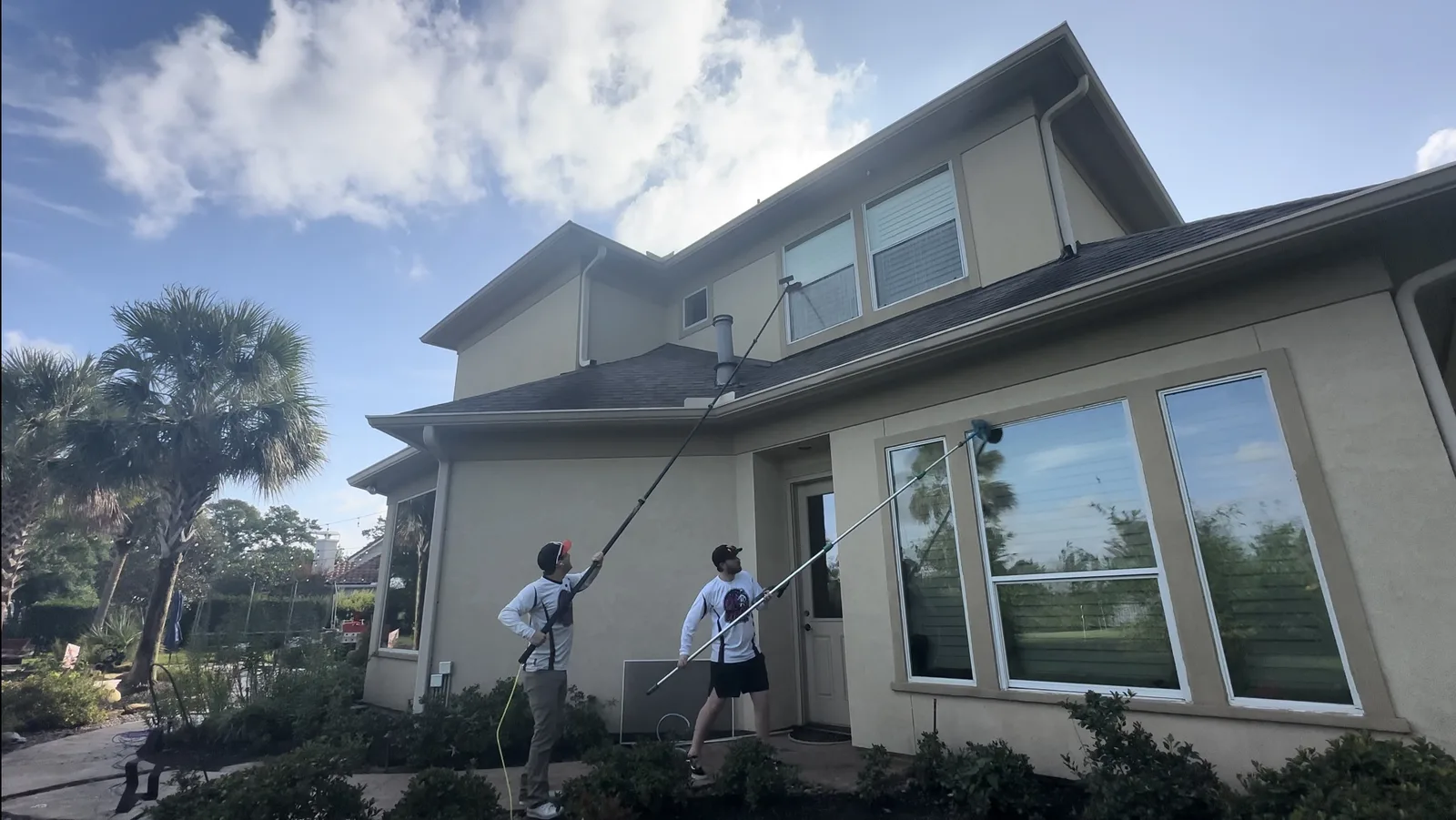
Soft Washing vs. Pressure Washing: Which One Does Your Home Need?
Most homes need both. The right method is decided surface by surface. Soft washing belongs on the roof, the siding, stucco, painted trim and window screens. Pressure washing belongs on flat concrete: the driveway, sidewalks, the patio and the pool deck.
That is the verdict. Use force where the surface can take it. Use cleaning solutions where it cannot. Get that split wrong on a roof and the damage does not wash back on.
What is the difference between soft washing and pressure washing?
The difference is what does the cleaning.
Pressure washing cleans with force. Water hits the surface hard enough to knock dirt loose. Pressure washing guides put the working range at roughly 1,300 to 4,000 PSI, depending on the surface.
Soft washing cleans with chemistry. Low pressure lays a cleaning solution on the surface. The solution sits for a few minutes, then the surface gets rinsed. Industry references draw the soft wash line at under 500 PSI. Many soft wash setups run closer to a strong garden hose.
That gap matters more than it sounds. Force takes off what you can see. A soft wash solution kills the mold, mildew and algae that made the stain.
Which surfaces need soft washing and which need pressure washing?
Here is the split most exterior cleaning work follows.
| Surface | Method | Why |
|---|---|---|
| Asphalt shingle roof | Soft wash | Pressure strips the granules that protect the shingle |
| Tile or metal roof | Soft wash | Pressure cracks tile and forces water under panels |
| Vinyl siding | Soft wash | Force cracks panels and pushes water behind the laps |
| Stucco | Soft wash | Pressure etches the finish and opens hairline cracks |
| Fiber cement and Hardie siding | Soft wash | The paint layer chips under force |
| Brick and limestone | Soft wash | Older mortar joints wash out under high pressure |
| Painted wood trim and soffits | Soft wash | Force lifts paint and drives water into the wood |
| Window screens | Soft wash | Thin mesh bends and tears |
| Gutter exteriors | Soft wash | Aluminum dents and the coating strips off |
| Concrete driveway | Pressure wash | Concrete takes force, and force lifts oil and dirt |
| Sidewalks and walkways | Pressure wash | A surface cleaner at pressure leaves an even finish |
| Patio and pool deck | Pressure wash | Algae film and stains need force to release |
| Wood deck or fence | Reduced pressure | Soft wood fuzzes and splinters at driveway pressure |
Read down the table and the pattern shows up. Anything vertical or overhead usually gets a soft wash. Anything you walk or park on gets pressure.
Why should a shingle roof never get pressure washed?
Because the granules do not go back on.
The Asphalt Roofing Manufacturers Association is the trade group for shingle makers. Its published guidance says never to use a pressure washer on an asphalt shingle roof. High pressure causes granule loss and likely early failure of the roof system. Shingle makers publish the same instruction on their own maintenance pages.
Granules are the colored grit on the face of a shingle. They block UV light and shield the asphalt under them. Once they wash down into the gutter, the shingle ages faster.
There is a manufacturer warranty angle too. A shingle warranty from the maker covers manufacturing defects, not cleaning damage. A roof showing pressure washer granule loss gives that maker an easy reason to deny a claim.
The method that association publishes is simple. A cleaning solution goes on with a sprayer and sits for 15 to 20 minutes. Then the roof gets a thorough rinse at low pressure. That is soft washing, and it is the approach behind our roof cleaning.
Why does a soft wash stay clean longer?
Because most exterior stains are alive.
Black streaks on a shingle roof come from Gloeocapsa magma, a blue-green algae that travels through the air. It feeds on the limestone filler used in modern shingles. The green film on a shaded wall is algae and mildew doing the same thing on siding.
Blast that growth off with water and the wall looks clean that afternoon. The living layer under it stays put. In San Antonio humidity it darkens again quickly.
A soft wash solution kills the growth at the root instead of knocking the color off. Soft wash references point to that as the reason treated roofs and walls hold their look longer.
Which method does a San Antonio home need?
Almost every home here needs both, in different places.
Summers are hot and humid, which is what algae and mildew want. North-facing walls and walls shaded by live oaks go green first. Roofs streak black. That whole list is soft wash work, which is why house washing runs at low pressure.
Concrete is a different job. Live oaks drop tannin and sap that stain flatwork. Caliche dust films driveways near new construction on the I-35 and 281 corridors. That is where driveway and concrete cleaning uses professional equipment at pressure.
Wood sits between the two. A cedar privacy fence or a wood deck cannot take driveway pressure. Deck and fence cleaning dials the pressure down so the grain does not raise.
How do you decide in thirty seconds?
Ask one question about the surface in front of you. Could water at pressure dent it, etch it, strip its finish or get behind it?
If the answer is yes, it is a soft wash surface. Roofs, siding, stucco, painted wood and screens all answer yes.
If the answer is no, it is a pressure washing surface. Driveways, sidewalks, patios and pool decks answer no.
Wood is the middle case. It sees pressure, just far less of it than concrete does.
The right method for your house
Houses and roofs get the soft wash method. That means low pressure with detergents that kill mold, mildew and algae at the root. Driveways and concrete get pressure washing with professional equipment. Which one your property needs is settled before a machine gets turned on.
Estimates are free, services start at $299, and financing is available on larger projects. Read how the low-pressure side works on our soft washing service page. Call or text (512) 905-8038 to get on the schedule.